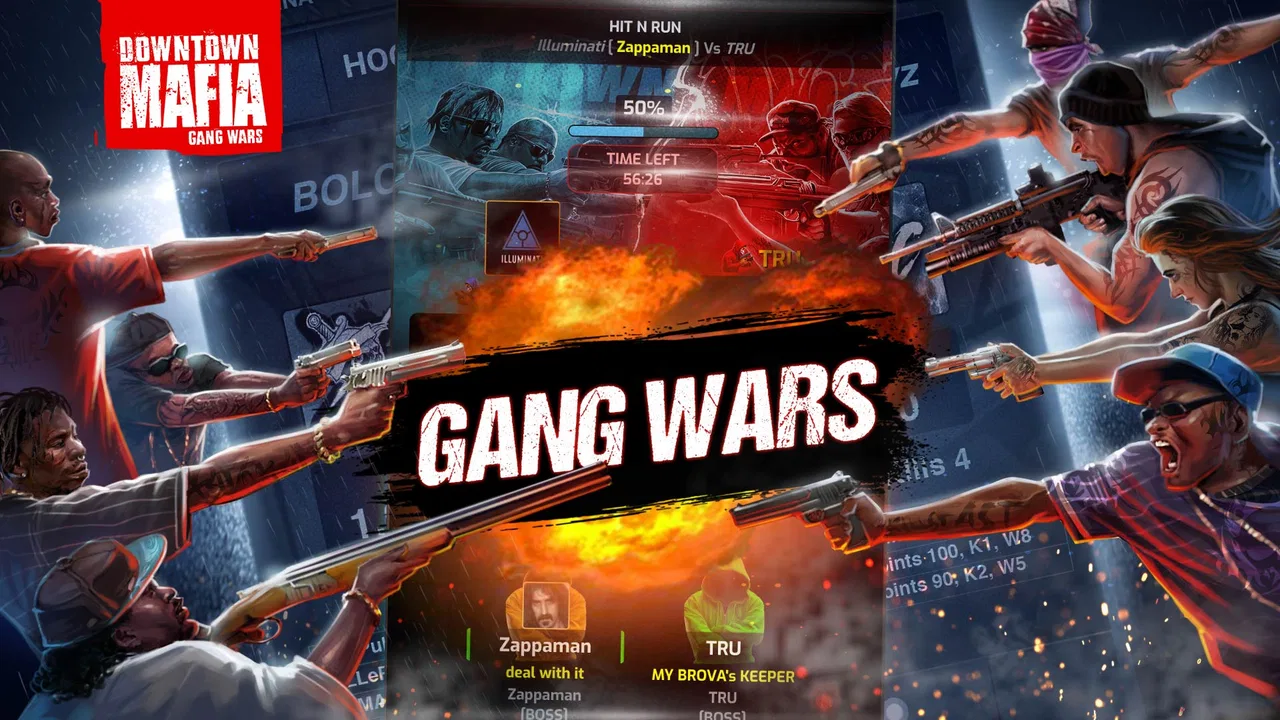
Downtown Mafia: Gang Wars Game
- 4.5
- Rating
- 5.00M
- Installs
- Free
- Price

 Analysis by App-foxy
I went into Downtown Mafia: Gang Wars Game expecting a quick crime-themed time filler, but its appeal is more specific than that. This is a text-driven role-playing game from DYNAMICNEXT, built around making decisions, checking progress, and returning regularly rather than watching an animated world unfold in real time. Its presentation is intentionally light, while the long-term loop depends on planning, patience, and interaction with the wider mafia community.
That distinction matters. If you want a visually rich action game with shooting, driving, or cinematic missions, this will feel extremely modest. If you enjoy games that let you make a few choices during a break, leave them working in the background of your routine, and come back to see how your character has developed, the format makes much more sense. I found it easiest to enjoy when I treated it as a persistent hobby rather than a conventional adventure.
What the current game feels like to play
The role-playing structure is presented through text and menus instead of detailed scenes. You read what is happening, choose an action, and manage the consequences through the available systems. That keeps the game accessible on older devices and makes individual sessions quick, but it also means the entertainment comes from decisions and progression rather than visual spectacle.
You May Also Like

 Blood Strike: 2.5 Anniversary
Blood Strike’s Loadouts Turn Every Drop Into a Tactical Gamble
A close look at Blood Strike’s custom loadouts: how fast access to signature weapons reshapes its battle royale rhythm, rewards preparation, and narrows the gap between fights.

 Pandora - Music & Podcasts
Pandora’s Music Is Easy to Start, but Harder to Recover
Pandora’s strength is its low-effort path from a seed to a station. Its weak spot is how much confidence it asks you to place in connection, setup, and quiet recovery.

 8 Ball Pool
 Is Built on Rivalries, Rematches, and Routine
A close look at the rivalries, rematches, shared routines, and unanswered safety questions that turn a quick pool match into a persistent mobile community.

 Samsung Music
’s Quiet Strength Is Playing What You Already Own
Its reach comes less from spectacle than from dependable access to a personal library. That simplicity is both the app’s strongest retention engine and its ceiling.

 AccuWeather: Weather Radar
AccuWeather Review: A Quick, Clear Forecast for Everyday Decisions
For everyday plans, the best forecast is the one you can understand quickly. AccuWeather makes rain timing, radar, and local conditions easy to act on, with a few trade-offs.

 Hill Climb Racing
Why Hill Climb Racing Still Turns Crashes Into One More Run
A tiny car, a bumpy hill and one more upgrade: Hill Climb Racing keeps resurfacing because its simple chaos makes every near-miss feel personal.
More From Our News Desk



The mafia setting gives those choices a recognizable identity. You are not simply improving a generic fantasy character or collecting abstract points; the language and presentation frame your progress around a criminal underworld. That theme is useful because it gives routine tasks a little personality, although players who dislike gangster fiction may find the atmosphere repetitive over time.
In my experience, the best sessions were short and deliberate. I would open the game, review what had changed, decide which activity deserved attention, and then leave rather than forcing myself to stay. That rhythm suits a text-based idle RPG particularly well. It does not demand the same uninterrupted concentration as a traditional role-playing game, and it can fit into a commute, a lunch break, or a few minutes before bed.
The trade-off is that the game asks you to supply some of the excitement yourself. There is no promise of constant visual feedback or dramatic action. Progress can feel satisfying when you understand why a decision helped, but slower when several choices appear to produce only small changes. New players should give the systems time before deciding whether the quiet pace works for them.
Why the idle structure changes the way I recommend it
Idle design is often misunderstood as a game that plays itself. Here, the more useful interpretation is that the game reduces the need to remain present every second. Your role is still to decide how to use opportunities, how often to check in, and where to focus your attention. That makes efficiency more important than speed.
A practical approach is to avoid tapping through every available option immediately. I found it better to look at the whole situation first, identify the action that supports my current goal, and then spend resources only when the benefit was clear. This prevents the common mistake of spreading progress too thinly across several competing priorities.
Another useful habit is to make the game part of an existing routine instead of letting it interrupt the entire day. A morning check can establish the next direction, while an evening visit can be used to review progress and prepare the next step. This works better than repeatedly opening the game without a plan, especially for players who are sensitive to notification-heavy or repetitive mobile games.
The social side also affects the experience. The store description positions the game as a social MMORPG, so it is not designed solely as a private progression tracker. Interaction with other players is part of the identity, and that gives the otherwise menu-focused format a stronger sense of place. Still, anyone joining only for a solo campaign should understand that the community angle is not just decoration; it is part of what makes the setting feel alive.
How the developer’s long-running release history affects expectations
The game was released on October 2, 2012, which helps explain both its strengths and its limitations. It belongs to an older generation of mobile role-playing design, when compact interfaces and persistent text systems could carry more of the experience. That history is valuable for players who enjoy classic browser-style or menu-based games, but it also means the presentation may feel dated beside newer Android and iOS releases.
The current version is 0.9.40. I would read that version number as a sign that the product is still being maintained or shaped rather than as evidence of a complete visual reinvention. The important point for a new player is not to expect a modern blockbuster interface simply because the game remains available. Its identity continues to come from the underlying text and progression model.
That long lifespan is also a positive in a practical sense. A game that has remained available for many years has had time to establish its basic concept and attract a continuing audience. The store shows a 4.5 average from around 4.3 thousand ratings, with roughly 647 written reviews, and more than 5 million installs. Those figures suggest that the unusual format has found a substantial audience, although popularity alone cannot guarantee that its slower style will suit every player.
The current release should therefore be judged on its intended experience rather than compared unfairly with graphics-first games. I would not install it expecting a visual upgrade to a console crime game. I would install it expecting a compact, persistent mafia-themed role-playing system that rewards regular attention and social participation.
What existing players gain from the current version
For returning users, a version update is most meaningful when it preserves the reasons they started playing while making daily management less frustrating. In this case, the continuing availability of the game supports that kind of relationship. Players who already enjoy its text-heavy structure do not have to abandon the format for a completely different style of game.
That continuity can be especially useful for people who have built a personal routine around the game. A short daily visit is easier to maintain when the controls and overall logic remain familiar. The downside is that a long-term player may notice the age of the design more sharply than a newcomer. Once the novelty has faded, repeated menus and incremental progress can feel more like maintenance than adventure.
I would advise established players to revisit their goals rather than simply repeating old habits. Decide whether you are playing for social contact, competitive improvement, collection, or the satisfaction of steady advancement. The same systems feel different depending on that goal. Without a clear reason to check in, the idle loop can become automatic and lose its charm.
New players should also avoid measuring their first sessions against people who have been present for a long time. Persistent games naturally create differences between newcomers and established accounts. A better early objective is to learn how the game communicates progress, discover which actions fit your preferred pace, and determine whether the community element adds value for you.
Where the experience still has friction
The biggest limitation is presentation. Text and menus can be wonderfully efficient, but they cannot provide the sensory impact of a modern action RPG. If you want animated combat, detailed environments, voice acting, or a strong cinematic storyline, this game is the wrong choice. Its simplicity is not a temporary tutorial layer; it is central to the design.
The second limitation is the possibility of repetition. Idle games depend on recurring actions, and the mafia theme does not automatically make every cycle feel fresh. I enjoyed the sense of gradual development, but I would not recommend marathon sessions. The game works better when played in measured visits, because extended tapping can expose how much of the experience is built around routine.
There is also a monetization consideration. The game is free to install, but in-app purchases range from $0.99 to $99.99 per item. That broad range means careful spending matters. I would not buy anything simply because progress feels slow during the first session. First learn the normal rhythm, identify what actually saves time or improves enjoyment, and set a personal limit before spending.
This is particularly important in an idle game because impatience can be mistaken for necessity. When progress is deliberately gradual, a purchase may feel attractive at the exact moment when waiting or changing strategy would have been enough. My practical advice is to treat purchases as optional convenience, never as the price of understanding whether you like the game.
The Teen content rating is another useful signal for families. It indicates that the game is aimed at an older audience than young children, which fits the criminal theme. Parents should consider whether that setting and the social MMORPG element are appropriate for the player, rather than judging suitability only by the simple text-based presentation.
Who will enjoy it, and who should skip it
I would recommend this game to someone who likes persistent progression, compact sessions, and the feeling of managing a character through choices rather than direct control. It is a good match for players who remember older text-based online games or who find modern mobile releases too demanding, too crowded with animation, or too focused on rapid reflexes.
It can also suit a player with an irregular schedule. Someone who has ten minutes between appointments may get more from this than from a game that requires a full uninterrupted match. The ability to return, inspect the situation, and make a few decisions gives the experience a flexible shape.
I would skip it if your main reason for playing a mafia game is action. There is no point choosing a text-centered RPG and hoping it will eventually become a driving or shooting experience. I would also steer away if you dislike repeated check-ins, social competition, or gradual gains. A story-led single-player RPG may be better for someone who wants a clear beginning, middle, and ending.
Players who prefer deep visual customization should look elsewhere as well. The appeal here is not the appearance of an avatar moving through a detailed city. It is the accumulation of decisions and the identity created by taking part in a persistent criminal-themed community.
A realistic daily routine and three useful habits
Imagine you are waiting for a train in the morning. You open the game, check your current position, and choose one priority instead of trying to handle everything at once. During lunch, you return to see whether the decision produced the expected result. In the evening, you review what remains useful and prepare the next action. That routine keeps the game present without allowing it to consume the whole day.
The first habit I recommend is planning before spending. In menu-heavy games, the fastest visible option is not always the best long-term choice. Read the available information, decide what kind of progress matters today, and avoid using resources merely because they are available.
The second is to separate experimentation from commitment. Early sessions are the right time to test how the game responds to different choices. Once you understand your preferred direction, concentrate on it instead of constantly resetting your priorities. This makes the slow progression feel more intentional.
The third is to use the social layer as a reason to return, not as pressure to remain online. Social MMORPGs can be more enjoyable when interaction supports your goals, but less enjoyable when every visit feels like an obligation. If the community aspect becomes stressful, shorten your sessions and decide whether the game still offers enough value on its own.
A fourth habit is to judge purchases by repeated usefulness. Because the price range extends from small impulse purchases to much larger items, I would wait until you have played long enough to know what problem you are solving. Spending to remove a single moment of impatience is rarely a good test of value.
How it compares with other role-playing options
Compared with a conventional mobile RPG, this game is lighter on visuals and heavier on persistence. A conventional title may give you more dramatic battles and a clearer narrative path, while this one asks you to shape a continuing routine. Neither approach is automatically better; they serve different moods.
Compared with a purely casual idle game, the mafia setting and social MMORPG identity give the experience more context. You are not only watching numbers rise. You are participating in a themed world where your choices are framed through criminal hierarchy and community interaction. The benefit is stronger identity; the cost is that players who want a completely private, frictionless idle toy may find the social layer unnecessary.
Compared with newer crime games, the advantage is accessibility and low visual demand. The disadvantage is obvious: newer alternatives may offer richer presentation, more immediate feedback, and more cinematic variety. I would choose this one when I want a quiet, ongoing game that fits around daily life, not when I want to feel immersed in a detailed open world.
What to watch before committing long term
Before settling in, pay attention to whether the core loop remains interesting after the initial curiosity fades. The first impression can be appealing because the format is unusual, but long-term enjoyment depends on finding a personal reason to keep making decisions. If you enjoy optimizing a routine and checking social progress, that reason may come naturally. If not, the repetition will probably become noticeable.
It is also worth watching how much the current version changes your day-to-day comfort. The release history and version 0.9.40 show that the game has continued as an active product, but I would focus on practical effects: whether the interface feels understandable, whether returning to the game is convenient, and whether the progression remains motivating without unnecessary spending.
For existing users, the key question is whether the long-established systems still reward their preferred play style. For newcomers, the key question is simpler: do you enjoy making small strategic choices and waiting for their results? That answer tells you more than the genre label alone.
My final view is positive but deliberately narrow. This is not a universal recommendation, and it does not try to compete with high-budget role-playing games on presentation. Its strength is the combination of a recognizable mafia theme, text-based decision-making, idle-friendly pacing, and a social setting that can support a long routine. Choose it for the habit of managing a persistent character, not for instant action.
DYNAMICNEXT’s game is free to start, available for devices running at least Android 7.0, and rated Teen. I would give it a fair trial through several short sessions before considering any purchase. If the quiet progression and community angle click with you, Downtown Mafia: Gang Wars Game can become a surprisingly durable companion. If you need visual drama, a tightly scripted story, or fast combat, another role-playing option will be a much better fit.
FAQs for Downtown Mafia: Gang Wars Game
01What is Downtown Mafia: Gang Wars about?
Downtown Mafia: Gang Wars is a crime-themed strategy and role-playing game centered on building a powerful underground organization. You recruit characters, expand your territory, complete missions, manage resources, and compete against rival gangs. The game combines city development, combat, progression systems, and story-driven activities, so it is aimed at players who enjoy long-term planning rather than only quick arcade battles.
02Can I play Downtown Mafia: Gang Wars offline?
The game may allow some basic activities to load on a device, but many of its main features generally depend on an internet connection. Multiplayer events, gang competitions, account synchronization, advertisements, purchases, and server-based progress may not work offline. For the most reliable experience, use a stable Wi-Fi or mobile-data connection and check the current store description for the developer’s latest connectivity requirements.
03Is Downtown Mafia: Gang Wars free to download and play?
Downtown Mafia: Gang Wars can typically be downloaded without an upfront purchase, but it may include optional in-app purchases. These purchases can provide premium currency, faster upgrades, special bundles, or additional resources. Progress is possible without spending money, although free players may need more patience when timers, energy systems, or competitive events become more demanding. Review purchase settings before handing the device to children.
04Does the game contain multiplayer or gang competitions?
Yes, the game’s gang-focused design is built around competition and cooperation with other players. Depending on the current version and available events, you may be able to join a gang, participate in group activities, attack or defend against rivals, and compete on rankings. These systems can make progression more engaging, but they may also require regular play and a dependable connection to stay competitive.
05Is Downtown Mafia: Gang Wars suitable for children?
The game is primarily intended for teenagers or adults because it uses crime, gang conflict, weapons, intimidation, and other mature themes as part of its setting. It may also contain advertising, social features, and optional purchases. Parents should check the age rating in their region, review privacy and chat settings, and consider enabling purchase restrictions before allowing younger players to install or use it.
Pros
- Strategic gang management adds depth beyond simple street fights.
- Short missions make it easy to play during brief breaks.
- Character upgrades give a clear sense of progression.
- Various weapons and crew roles support different play styles.
- Urban visuals and crime-themed atmosphere suit the mafia setting.
Cons
- Some upgrades may take considerable time without premium currency.
- The interface can feel crowded when managing several game systems.
- Combat may become repetitive after extended play sessions.
- Progress can feel slower once early missions are completed.
- An internet connection may be required for certain features.

Downtown Mafia: Gang Wars Game
Gallery